

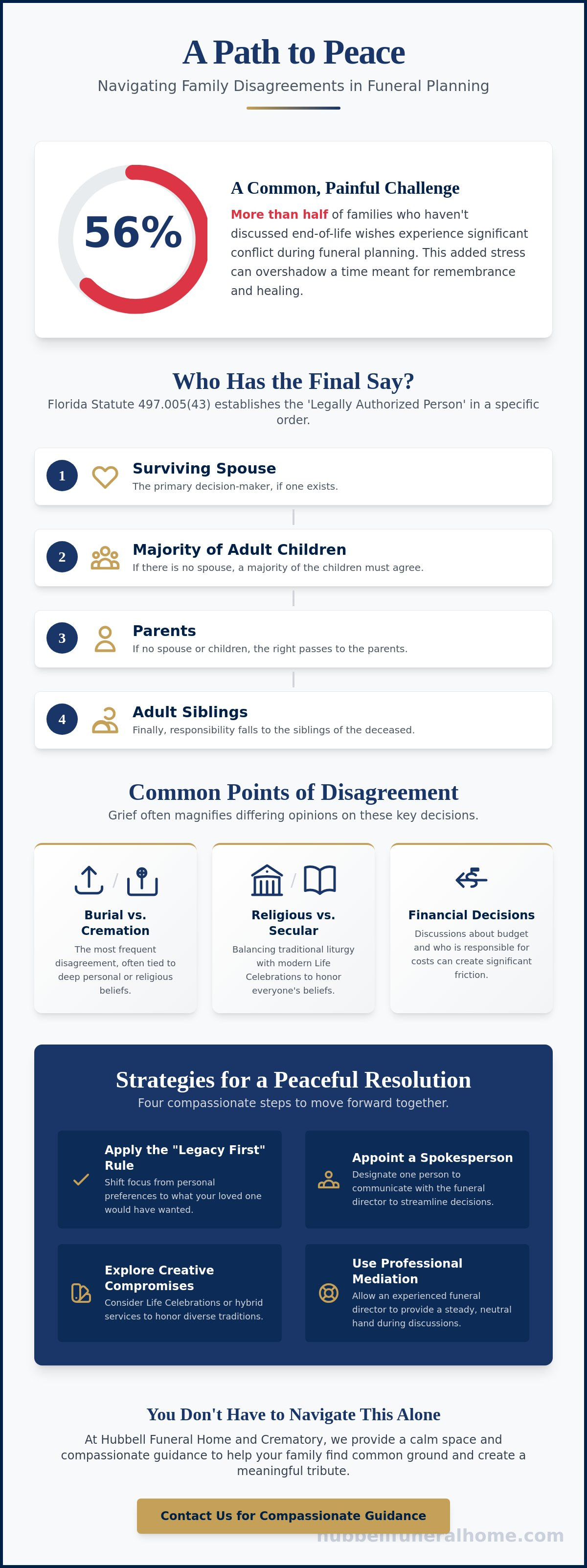
Did you know that 56% of families who haven't discussed end-of-life wishes end up facing significant conflict during the process? This common challenge means more than half of us will encounter these difficult moments. When you're already carrying the weight of loss, planning a funeral when family disagrees can feel like an insurmountable burden. You might feel unheard by more dominant voices or worry that a heated argument will overshadow the dignity of the service.
It's natural to feel anxious about legal authority or the fear of ruining a final tribute. At Hubbell Funeral Home and Crematory, we believe that every family deserves a path toward peace. In this guide, you'll learn how to manage disagreements with compassion and gain clarity on who holds the legal right to make decisions. We'll explore how professional guidance can help you move past the friction, allowing you to focus on the significance of the life lived and a service that brings everyone together in reverence. By shifting the focus back to your loved one's legacy, you can find a resolution that honors their memory without further tension.
Key Takeaways
- Identify the "Legally Authorized Person" under Florida law to clarify who holds the final decision-making power during the planning process.
- Apply the "Legacy First" rule to shift the focus from personal preferences to what your loved one would have truly wanted.
- Discover how planning a funeral when family disagrees becomes more manageable by appointing a single spokesperson to communicate with funeral directors.
- Explore Life Celebration services and hybrid options as creative ways to honor diverse family traditions and personal wishes.
- Learn how professional mediation and decades of local heritage can provide a steady hand during the most difficult family discussions.
Why Family Conflict After a Death is More Common Than You Think
It’s a quiet truth that many families discover only in the arrangement room: grief doesn't always look like tears. Sometimes, it looks like an argument over the color of a casket or the choice of a hymn. Planning a funeral when family disagrees is a common experience, yet it feels incredibly isolating when you're in the middle of it. The pressure to provide a perfect final tribute can turn small logistical choices into intense emotional battlegrounds, especially when blended families or estranged relatives are involved.
The Psychology of Grief and Control
When we lose someone we love, our world feels chaotic. To cope, many of us reach for anything we can control. This is often where "misplaced grief" begins. Instead of processing the pain, family members focus on the minutiae of the service. You might notice siblings suddenly reverting to their childhood roles; the "responsible one" takes over, while the "rebel" pushes back. It's often easier to "do something" like plan a service than it is to "feel something" as heavy as loss. If you find yourself in a heated debate, take a breath and ask: is this really about the urn, or is it about a hurt from years ago? Recognizing when a fight is about the funeral versus a past hurt is the first step toward peace.
Common 'Battlegrounds' in the Arrangement Room
Disagreements typically center on a few specific areas that carry heavy emotional weight. Navigating these choices while planning a funeral when family disagrees requires patience and a steady hand. These points of friction often include:
- Burial vs. Cremation: This is the most frequent point of total disagreement, as it involves deeply held personal, environmental, or religious beliefs.
- Religious vs. Secular Tones: Navigating differing faith levels within one family can be challenging, particularly when one person wants a traditional liturgy and another prefers a modern Life Celebration service.
- Financial Decisions: Budgetary constraints and deciding who is responsible for the final bill often cause friction.
Transparency is vital during these discussions. Under the FTC's Funeral Rule, you have the right to receive clear pricing and choose only the goods and services you want. This federal regulation helps ensure that financial discussions remain grounded in facts rather than assumptions. By understanding your rights, you can lower the emotional temperature and focus on what truly matters: honoring the legacy of the person you lost.
Understanding Legal Rights and the Florida 'Order of Precedence'
When emotions are high and opinions clash, it’s helpful to lean on a structured framework. In Florida, this framework is defined by Florida Statute 497.005(43), which identifies the "Legally Authorized Person" (LAP). It’s a common misconception that the executor named in a will automatically makes funeral decisions. In our state, the LAP has the primary right to control the disposition of the body, and this person may be different from the individual managing the estate. Establishing this legal boundary early on can actually help de-escalate tension. It provides a clear roadmap, allowing families to step back from emotional arguments and follow the established law.
Who has the Final Say in Florida?
Florida law follows a specific "order of precedence" to determine who holds the decision-making power. The hierarchy begins with the surviving spouse. If there is no spouse, the right passes to adult children. If there is more than one child, the law typically requires a majority of them to agree on the arrangements. This is often where planning a funeral when family disagrees becomes most complex. If adult children aren't available, the responsibility moves to the parents, and then to adult siblings. It’s also worth checking if a "Health Care Surrogate" was appointed before death, as they may have had specific authority over medical decisions that transitioned into end-of-life instructions.
Understanding your consumer rights under the Funeral Rule is just as important as knowing the state hierarchy. This federal law ensures that the LAP, whoever they may be, receives transparent information to make informed choices without feeling pressured by the industry or other family members. Having these facts at hand can transform a heated debate into a calm, legal discussion.
What if there is no Written Directive?
When a loved one passes without leaving a "Designated Representative" form or written instructions, the law follows the default path mentioned above. This can lead to a "legal limbo" where family members feel stuck or unheard. At Hubbell Funeral Home and Crematory, we act as a steady hand to help you identify the correct legal decision-maker according to Florida statutes. We’ve guided many families through these delicate conversations, ensuring that the process remains dignified and respectful. Our role is to provide professional assurance so you don't have to navigate these legal complexities alone.
To prevent these uncertainties for your own family, we highly recommend looking into pre-planning services. By documenting your wishes and naming a representative now, you remove the guesswork and potential for conflict later. If you're currently facing a disagreement, remember that the law exists to provide order when feelings are overwhelmed. Taking a moment to verify the LAP can often be the most compassionate step you take toward a peaceful resolution.
Practical Strategies for Resolving Disagreements with Compassion
How can you find a path forward when every decision feels like a hurdle? To manage planning a funeral when family disagrees, we suggest establishing a "Legacy First" rule. Before debating a specific detail, stop and ask: "What would our loved one have truly wanted?" This simple question often silences personal preferences and brings the focus back to the person being honored. It’s also helpful to appoint a single spokesperson. While everyone should have a voice, having one person communicate decisions to the funeral home prevents mixed signals and reduces the noise in an already loud room.
The Power of the Neutral Third Party
The arrangement room is designed to be a safe space where difficult conversations can happen with dignity. A funeral director serves as a steady mentor, using years of experience to suggest compromises you might not have considered yet. For example, if there is a split between a traditional burial and a modern memorial, we might suggest a cremation with a memorial service that includes traditional elements. If the conflict is spiritual, involving a celebrant or clergy member can help bridge religious gaps. Their presence ensures the service feels inclusive for everyone involved, regardless of their personal faith levels.
Communication Tools for Grieving Families
Communication during a crisis requires intentionality and patience. Use "I" statements to express your needs without accusing others. Instead of "You're being difficult," try "I feel overwhelmed when we don't have a clear plan." If things get too heated, take a "time-out." Most decisions don't have to be made in the first hour. We recommend setting a clear meeting agenda to keep the focus on the service rather than past family history. You can also use "round-robin" listening, where each person speaks for two minutes without being interrupted. Finally, we suggest keeping written summaries of every decision. This ensures everyone heard the same thing and prevents confusion later in the week. By slowing down the rhythm of the conversation, you create room for healing while planning a funeral when family disagrees.
Creative Compromises: Life Celebrations and Personalized Options
Planning a funeral when family disagrees often feels like choosing between two rigid extremes. But what if there was a middle ground? Life Celebration services offer a flexible alternative to traditional rites, allowing you to blend diverse family wishes into a single, cohesive event. Instead of one person "winning," hybrid services combine the solemnity of a traditional funeral with the warmth of a modern memorial. Splitting the service into a private graveside ceremony for immediate family and a larger public celebration can also satisfy different needs for intimacy and community support. This approach respects everyone's emotional needs while keeping the focus on the life lived.
For families who find themselves at an impasse regarding burial or traditional cremation, water cremation provides a gentle, eco-friendly option that often satisfies both parties. It offers a soft, natural alternative to flame-based methods, which can be a comforting compromise for those wary of traditional choices. By providing options that feel less final and more restorative, you can lower the emotional temperature in the room.
Bridging the Religious vs. Secular Divide
One of the most frequent points of tension involves differing faith levels. You don't have to choose between a strictly liturgical service and a completely secular one. We often suggest including a dedicated moment of silence or non-religious readings alongside traditional prayers. Using a neutral venue in Belleair Bluffs can also help create a more relaxed, inclusive atmosphere where storytelling and legacy take center stage. This shifts the focus from rigid rites to the personal history that everyone in the room shares and admires. It’s about creating a space where every family member feels their beliefs are respected.
Memorial Merchandise as Personal Tributes
Sometimes the best way to resolve a disagreement is to ensure everyone has a personal way to remember. Memorial merchandise like keepsake jewelry or parting stones allows each family member to have their own private connection to the deceased. If siblings are struggling to agree on a final resting place, distributing "mini urns" ensures that everyone can keep a portion of their loved one's remains in their own home. Customizing a casket or an urn to reflect a specific interest, like a favorite hobby or local heritage, creates a shared point of pride that can soften the edges of a difficult day. These small, personalized choices allow for individual expression within a collective goodbye.
If you're feeling stuck between conflicting visions, our team can help you design Life Celebration Services that honor every voice in your family.
How Hubbell Funeral Home and Crematory Facilitates Peaceful Transitions
Planning a funeral when family disagrees is one of the most taxing experiences a household can face. At Hubbell Funeral Home and Crematory, we've spent more than 60 years navigating end-of-life care alongside families in Belleair Bluffs. We understand that our role isn't just to coordinate logistics. We serve as a steady hand during an emotional storm. Our approach is neighborly and rooted in the local community, ensuring that you feel supported rather than processed. We invite you to join us for a no-pressure consultation where we can listen to your specific situation and offer guidance tailored to your family's unique dynamics.
A Steady Mentor in Your Time of Need
Our directors act as patient advisors who manage the complex minutiae of the process. This allows you to focus on the emotional journey of healing rather than the stress of paperwork. With a heritage of serving Belleair Bluffs families through multiple generations, we bring a sense of longevity and reliability to the arrangement room. We manage the details so you don't have to. Whether you're seeking specialized honors for a veteran or a unique Life Celebration service, we ensure every detail reflects the significance of the life lived. We've seen how a calm presence can transform a room full of tension into a space of reverence and shared remembrance. Our goal is to provide professional assurance without feeling clinical or detached.
Starting the Conversation Today
One of the most effective ways to prevent the stress of planning a funeral when family disagrees is to document your wishes ahead of time. It’s never too early to provide your family with the gift of clarity. Through our "Legacy Initiative," we focus on storytelling and personal history, helping you craft a narrative that truly represents your life. This proactive step removes the burden of guesswork from your children or spouse. It's a final act of care for those you love. We welcome you to contact us for a tour of our Belleair Bluffs facility. Seeing the "neutral ground" firsthand can often provide the comfort and confidence you need to start these important conversations. Hubbell Funeral Home and Crematory is here to be your partner in this journey, offering humble expertise every step of the way.
Finding a Path Toward Peace and Remembrance
Conflict during loss is often misplaced grief manifesting as a need for control. By understanding Florida's legal order of precedence and embracing creative compromises like Life Celebrations, you can move from friction to a shared focus on legacy. Planning a funeral when family disagrees doesn't have to be a source of lasting pain. Instead, it can be an opportunity to find a resolution that honors your loved one's unique story through meaningful conversation and mutual respect.
Since 1963, our family has served as a steady hand for our neighbors. We specialize in navigating the complexities of Florida funeral law and Legally Authorized Person (LAP) requirements, ensuring every step is clear and dignified. Whether you're interested in innovative options like Water Cremation or a personalized memorial, we provide the quiet expertise needed to bridge differences. Contact Hubbell Funeral Home and Crematory for compassionate guidance and mediation as you begin this journey. You don't have to navigate these difficult decisions alone. We're here to help you create a tribute that brings your family together in healing.
Frequently Asked Questions
What is the 'Order of Precedence' for funeral decisions in Florida?
Florida law follows a strict hierarchy starting with the surviving spouse, then adult children, then parents, followed by adult siblings. This order identifies the Legally Authorized Person responsible for making final arrangements. This legal framework exists to provide clarity when emotions are high. If you're unsure where you stand in the hierarchy, we can help you verify your legal standing according to state statutes.
Can a sibling stop a cremation if the other sibling wants it?
Yes, a sibling can potentially stop a cremation if a majority of the adult children do not agree. In Florida, when there is no surviving spouse, the right to decide passes to the adult children as a group. If there's an even split or a lack of consensus among the children, a funeral home may require a court order or a unanimous agreement to proceed. This ensures the final decision respects the legal rights of all equal-ranking family members.
What happens if the family cannot reach a consensus on the funeral service?
The decision typically falls to the Legally Authorized Person as defined by Florida statute. When planning a funeral when family disagrees, this individual holds the final legal authority to sign contracts and authorize services. However, if multiple people have equal standing and cannot agree, the situation may require legal mediation. We always strive to facilitate a compromise that honors the deceased's legacy before reaching that point.
Does the person paying for the funeral get to make all the decisions?
No, the person paying for the service does not automatically gain the right to make all funeral decisions. Legal authority is determined by the Florida order of precedence, not by who provides the funding. While the person paying often works closely with our staff, they must still respect the wishes and legal rights of the Legally Authorized Person. This distinction helps ensure that decisions are based on the loved one's wishes rather than financial influence alone.
How can a funeral director help mediate a family argument?
A funeral director acts as a neutral third party and a steady mentor during these difficult conversations. We use our experience to suggest creative compromises, such as hybrid Life Celebration services, that incorporate different family viewpoints. By providing a calm, professional atmosphere, we help families shift their focus from personal friction to the meaningful celebration of a legacy. Our goal is to ensure the process remains dignified and respectful for everyone involved.
Is a written will legally binding for funeral arrangements in Florida?
In Florida, a will is primarily for the distribution of assets, and its instructions for funeral arrangements aren't always strictly legally binding on the funeral home. However, it serves as strong evidence of the deceased's intent. The most effective way to ensure your wishes are followed is to complete a Designated Representative form or utilize our pre-planning services. This provides the legal clarity needed to prevent disagreements among surviving family members later.
Can we have two separate memorial services to avoid conflict?
While possible, having two separate services can often increase financial strain and deepen emotional rifts. We usually recommend a single, inclusive service that incorporates diverse elements to satisfy different family needs. For example, you might choose a private graveside service for immediate family followed by a public Life Celebration. This approach allows for different levels of intimacy and public remembrance without the need for entirely separate events that might exclude certain relatives.
What should I do if I am being excluded from the planning process?
First determine your legal standing in the Florida order of precedence if you find yourself left out. If you're a Legally Authorized Person, you have a right to be involved in the decision-making process. If you aren't the primary decision-maker, we suggest reaching out to the family spokesperson to express your desire to contribute a specific tribute. When planning a funeral when family disagrees, open and honest communication is the best way to ensure your voice is heard during the journey of remembrance.