

What if the person paying for a final farewell isn't actually the one legally allowed to decide on the service? It's a heavy realization to face when you're already carrying the weight of loss. You likely believe that family should come together during these times, yet without a clear roadmap, even the most well-meaning relatives can find themselves at odds. Understanding who has the right to make funeral arrangements in Florida is essential to ensuring your loved one's legacy is honored without the added burden of legal uncertainty or family conflict.
We're here to help you move through this process with a sense of peace and professional assurance. This guide clarifies the specific legal priority list established by Florida law, from surviving spouses to adult children and beyond. You'll also learn how proactive pre-planning can override these default rules, giving you the power to protect your wishes and your family's harmony. By the end, you'll feel prepared to walk into any funeral home with the confidence that you're following the right path for your family.
Key Takeaways
- Navigate the strict legal priority list that ensures every decision is made with proper authority and respect.
- Understand exactly who has the right to make funeral arrangements in Florida to prevent confusion and protect family harmony.
- Learn why written, witnessed instructions are the only way to ensure your personal wishes override the state's default legal order.
- Recognize the difference between the legal power to make decisions and the financial responsibility for those final choices.
- Discover how professional guidance can handle the legal minutiae for you, allowing your family to focus on a meaningful celebration of legacy.
The Hierarchy of the "Legally Authorized Person" in Florida
When a life ends, the focus naturally shifts to honoring a legacy. However, the logistical reality of who holds the legal pen soon follows. Florida law is very specific about who has the right to make funeral arrangements in Florida. Under Florida Statute 497.005(43), the state defines a "Legally Authorized Person" (LAP). This isn't just a suggestion; it's a strict legal requirement. Funeral homes follow this hierarchy to ensure that every decision, from a traditional burial to a gentle water cremation, is made by the individual with the legal standing to do so. This structure protects the family from future disputes and provides the funeral home with the necessary authority to proceed with the service.
While Florida law dictates the hierarchy, the FTC's Funeral Rule provides broader consumer protections at the federal level. It ensures you have the right to choose only the services you want and to receive transparent pricing, regardless of where you fall on the priority list. Understanding these layers of protection helps you feel more secure as you begin the arrangement process.
The 2026 Florida Priority List
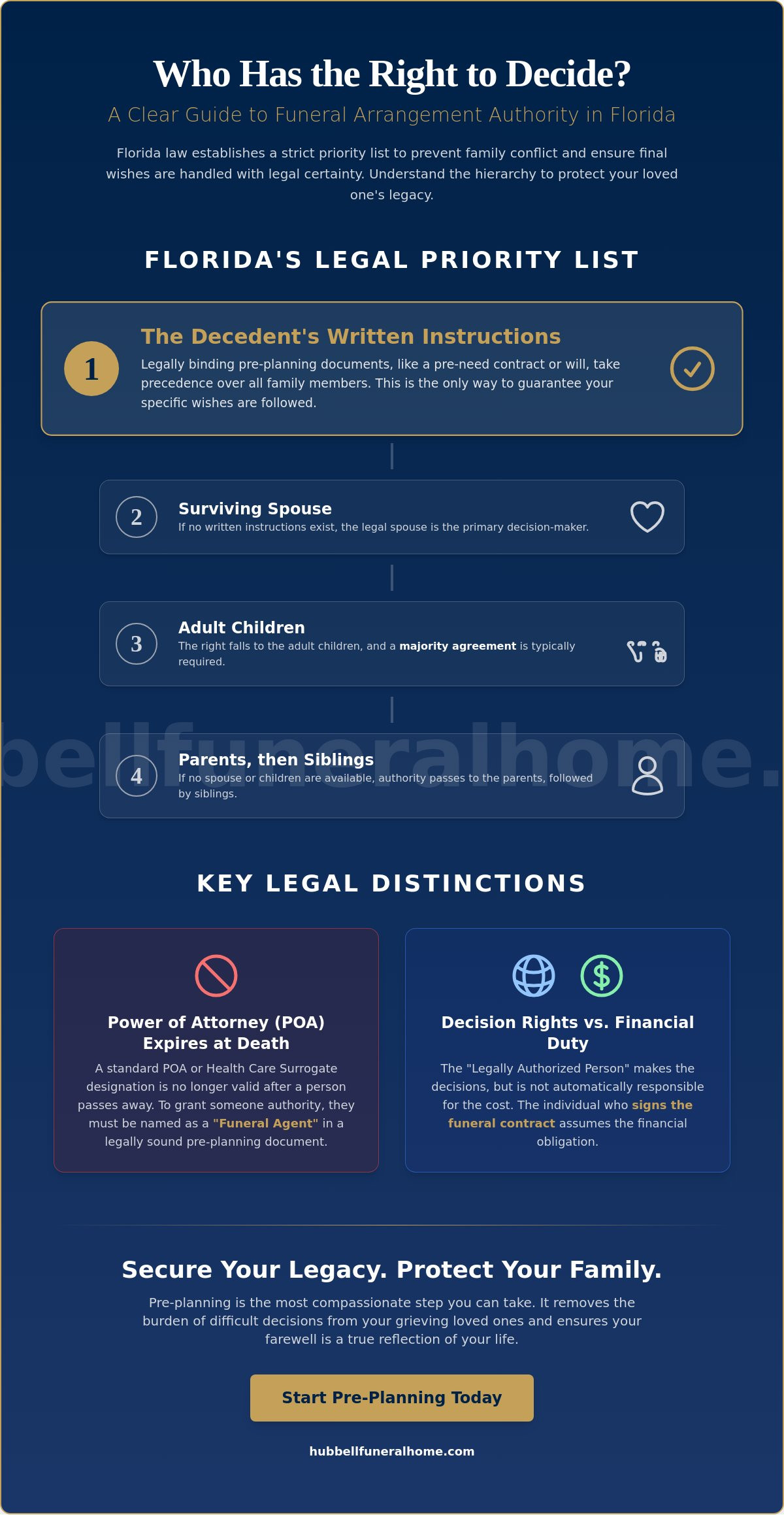
- 1. The Decedent: If the person who passed away left legally binding written instructions, their wishes take precedence over everyone else.
- 2. The Surviving Spouse: Unless there is a legal disqualification, the spouse is the primary decision-maker.
- 3. Adult Children: If there's no spouse, the right falls to the children. If there are multiple children, the law typically requires a majority to agree on the arrangements.
- 4. Parents and Siblings: If no spouse or children exist, the responsibility moves to the parents, followed by the siblings of the deceased.
Does Power of Attorney (POA) Count After Death?
A common point of confusion involves the Power of Attorney (POA). Many family members are surprised to learn that a standard POA expires the moment a person passes away. It doesn't matter how long you've handled their finances or medical care; that authority stops at death. Similarly, a Health Care Surrogate designation typically only covers medical decisions while the person is alive. To ensure someone specific has the authority to make arrangements, they should be designated as a "Funeral Agent" within a formal estate plan or pre-planning document. This is the most effective way to guarantee your chosen representative can act on your behalf.
It's also vital to distinguish between who makes the choice and who pays the bill. The person at the top of the priority list holds the decision-making power, even if someone else is providing the funds. However, the person who signs the final contract at the funeral home is generally the one responsible for the financial obligation. If you are unsure who has the right to make funeral arrangements in Florida within your specific family dynamic, starting with the state-mandated list is the first step toward clarity. We find that establishing this legal foundation early helps families avoid unnecessary tension during an already difficult time.
How Written Instructions Pre-empt the Standard Priority
While the state provides a default list to determine who has the right to make funeral arrangements in Florida, you aren't bound by those choices if you take action ahead of time. In fact, written instructions are the only legal mechanism that allows you to "skip" the standard hierarchy. Under Florida Statutes Chapter 497, your own documented wishes hold the highest level of authority. For our neighbors in Belleair Bluffs, this means that your personal vision for your legacy remains intact, even if your survivors have differing opinions. These documents must be clearly signed, dated, and in many cases, witnessed to be considered legally binding. When these requirements are met, funeral homes are legally obligated to follow your directives rather than the preferences of the next of kin.
Think of these instructions as a final act of care for your family. By making these decisions now, you remove the guesswork and potential for conflict during a time of deep grief. It's a compassionate way to ensure your celebration of life reflects your true story while lifting the emotional burden from those you love most.
Designating a Representative via DD Form 93
For veterans and active-duty service members, Florida law recognizes a specific and powerful document known as the DD Form 93. This Record of Emergency Data allows a service member to designate exactly who will manage their final arrangements. Interestingly, this form can override even a surviving spouse or adult children. It's a vital tool for those who have served, ensuring their final honors are handled by a trusted person of their choosing. If you're looking for local support or want to connect with others who understand the unique needs of our service members, the American Legion Seminole Florida is an excellent resource for honoring veterans in our community.
The Role of Pre-Planning Services
Choosing to utilize pre-planning services is the most effective way to solidify your status as the primary decision-maker. There's a significant legal difference between a simple "wish list" left on a notepad and a formal pre-need contract. A pre-need contract is a binding agreement that details your choices and, in Florida, ensures your funds are protected in specialized trust accounts. This legal framework provides peace of mind that your arrangements, whether you prefer a traditional service or a modern memorial, are secured and legally recognized. If you haven't yet documented your wishes, taking a moment to explore our pre-planning options can be the first step toward protecting your family's future peace.
When the Right is Revoked: Disputes and Disqualifications
Life doesn't always follow a clean script. While we've discussed the standard hierarchy, certain circumstances can strip a person of their decision-making power. Florida law recognizes that specific actions or deep-seated disagreements can disqualify someone from their role as the "Legally Authorized Person." If the individual at the top of the list is unable or unfit to serve, the responsibility doesn't vanish. Instead, it moves to the next eligible person in line. This ensures that the journey toward a meaningful life celebration continues, even when the path is rocky.
One of the most common hurdles occurs when multiple people hold equal authority, such as adult children. If siblings are tasked with deciding between a traditional funeral service or direct cremation, Florida law typically looks for a majority consensus. However, if a "good faith" dispute arises and the family is deadlocked, funeral homes are legally required to pause. They cannot proceed until the dispute is resolved. Picking a side without majority consent could lead to significant liability for the provider. Understanding the nuances of Florida funeral arrangement laws is vital when determining who has the right to make funeral arrangements in Florida during these high-stress moments.
Handling Family Disputes in Pinellas County
In our local Pinellas County community, we've seen how these deadlocks can stall the healing process. When siblings can't agree on burial versus cremation, the matter may eventually require a court order to move forward. This is a stressful and costly outcome that no one wants during a time of loss. Hubbell Funeral Home and Crematory encourages families to engage in "Meaningful Conversations" long before a crisis occurs. By discussing legacy and personal storytelling early, you can align expectations and avoid the friction that often comes with high-stakes decisions. Our goal is to act as a steady mentor, helping you navigate these conversations with grace.
Disqualification Due to Criminal Activity
There are also specific legal triggers that immediately revoke a person's authority. Florida statutes are very clear: any person arrested for domestic violence against the deceased is disqualified from making final arrangements. This is a critical component of the state's broader "Slayer Laws," which prevent individuals from exerting control after a criminal act. It's important to recognize that a conviction isn't always necessary. An arrest alone can be enough to trigger a shift in authority. If your family faces this difficult legal situation, the right to decide moves down the hierarchy to the next eligible relative. This protection ensures the deceased is cared for with the dignity they deserve, free from the influence of those who caused them harm.
Financial Responsibility vs. Decision-Making Rights
One of the most frequent questions we hear in Belleair Bluffs is whether the person paying for the service is the one who gets to make the final calls. It’s a common point of confusion during a sensitive time. While we've established who has the right to make funeral arrangements in Florida, that legal authority is distinct from the source of payment. The "Legally Authorized Person" holds the power to choose the type of service, whether that's a traditional burial or a memorial with water cremation. However, the individual who actually signs the contract at the funeral home is the one who assumes financial liability. If you're the one signing, you're responsible for the bill, even if you aren't the primary decision-maker or the sole heir.
Florida law recognizes the importance of a dignified farewell and allows for "reasonable" funeral expenses to be reimbursed from the deceased's estate. This means that if you pay out of pocket initially, you may be able to claim those costs back during the probate process. In Pinellas County, these expenses are typically treated as a high-priority claim, ensuring that the person who stepped up to handle the arrangements isn't left with an unfair burden. Understanding this distinction can help lower the temperature in family discussions and keep the focus on celebrating a life well-lived.
Accessing Estate Funds for Funeral Costs
Navigating the financial side of a loss requires specific documentation. To access bank accounts or file for estate reimbursement, you'll need certified death certificates. In our local area, the District 6 Medical Examiner must also provide specific authorizations for certain services, which can affect the timing of these financial steps. Reviewing Pinellas County obituaries is often a helpful starting point for families to see how others have documented these milestones for legal and memorial purposes. Additionally, you should look into Social Security benefits; survivors can often use form SSA-1724 to claim any unpaid benefits that were due to the deceased, which can help offset immediate costs.
Life Insurance and Pre-Need Contracts
The transition is much smoother when funding is secured in advance. When we sit down with a family, one of our first steps is to verify if a pre-arranged plan or a pre-need contract already exists. These plans often lock in prices and designate the funding source, making it clear who has the right to make funeral arrangements in Florida without financial stress. If life insurance is available, you can often use an "assignment of benefits." This allows the insurance company to pay the funeral home directly, sparing the family from having to find the funds upfront. If you're unsure about available resources, we can help you explore our service options to find a path that respects both your loved one’s legacy and your family's budget.
How Hubbell Funeral Home and Crematory Navigates Florida Law for You
We understand that the legalities surrounding a loss can feel overwhelming when you're already carrying the weight of grief. The family at Hubbell Funeral Home and Crematory prioritizes clear, honest communication over legal friction. During our initial consultation, we'll walk you through the process of identifying who has the right to make funeral arrangements in Florida. This isn't just about checking a legal box; it's about ensuring the person who knew your loved one best is the one guiding the celebration of their legacy. By providing professional assurance without a clinical feel, we help alleviate the emotional burden on your family.
Our team offers specialized support for a wide range of choices, including traditional services and cremation services near me. Whether your family is considering anatomical donation or requires a transfer to another state, we manage the minutiae so you don't have to. We act as a steady mentor, positioning ourselves as a partner in your journey of remembrance and healing. This allows you to shift your focus from the logistics of the industry to the significance of the life lived.
A Compassionate Partner in Belleair Bluffs
One of the most complex parts of the arrangement process involves coordinating with local authorities. In Pinellas County, specific paperwork must be filed with the District 6 Medical Examiner before certain services can proceed. Hubbell Funeral Home and Crematory handles these administrative hurdles on your behalf, ensuring every requirement is met with precision. This includes facilitating modern, gentle alternatives like water cremation, which is an eco-friendly choice for families seeking a different path. Whether you're in Largo, Clearwater, or the wider Tampa Bay area, we provide the steady hand needed to navigate these local requirements with dignity and reverence.
Next Steps: Securing Your Legacy Today
You don't have to wait for a crisis to find clarity for your family. Starting a pre-planning conversation with the team at Hubbell Funeral Home and Crematory is the most effective way to protect your survivors from legal doubt or disagreements. By documenting your wishes today, you ensure there's never a question about who has the right to make funeral arrangements in Florida for your specific service. It’s a gift of certainty and a final act of care that allows your family to focus on storytelling and healing rather than legal hierarchies. Contact Hubbell Funeral Home and Crematory today to discuss your family’s needs.
Protecting Your Legacy and Your Family's Peace
Navigating the legal landscape of loss is far simpler when you have a clear map. You've discovered how Florida law prioritizes specific family members and why the person signing the final contract carries the financial weight. Most importantly, you now know that your own written instructions are the only way to truly guarantee your wishes are honored. By documenting your preferences today, you remove the heavy burden of doubt from your loved ones during their most difficult moments.
Gaining clarity on who has the right to make funeral arrangements in Florida is the first step toward a secure plan. Since 1963, our family has served Belleair Bluffs with a deep commitment to Florida Statute 497 compliance. Whether you prefer a traditional service or are looking for local pioneers in eco-friendly options like water cremation, Hubbell Funeral Home and Crematory is here to offer a steady hand. We manage the legal details so you don't have to. Take a moment to secure your future and provide lasting comfort for your family. Plan Ahead with Hubbell Funeral Home and Crematory
Frequently Asked Questions
Can a girlfriend or boyfriend make funeral arrangements in Florida?
No, a domestic partner or significant other does not have the automatic legal right to make arrangements unless they were formally designated in a written document. Florida law follows a strict blood and marital hierarchy. To grant a partner this authority, you must name them as your "funeral agent" in a witnessed, written directive before your passing.
What happens if the next of kin cannot be found in Florida?
If the primary individual on the priority list cannot be located after a diligent, good faith search, the right moves down to the next person in the hierarchy. In rare cases where no family members can be found, the responsibility may eventually fall to a public administrator or the medical examiner's office. We work closely with families to document these search efforts to ensure the process remains legally compliant.
Does the executor of the will have the right to make funeral arrangements?
No, the executor of a will does not automatically hold the right to decide on funeral services in Florida. While an executor manages the estate's finances and property, the "Legally Authorized Person" defined by state statute holds the power over final disposition. These are two distinct roles, though sometimes the same person may hold both positions if they are also the surviving spouse or a child.
Who is the legally authorized person for a deceased veteran?
For veterans, the individual designated on the Department of Defense (DD) Form 93 is the primary authority. This form is a federal document that overrides the standard state hierarchy. It allows service members to choose exactly who will handle their funeral honors and final arrangements, providing a clear path for their survivors.
Can I change my mind about cremation if I am the legally authorized person?
Yes, you can change the type of service as long as the process has not yet begun. As the person who has the right to make funeral arrangements in Florida, you hold the final say on whether to proceed with a traditional burial, flame cremation, or water cremation. Once an irreversible step is taken, however, the decision is final, so we encourage families to take the time they need to feel certain.
What if the majority of adult children cannot agree on the funeral service?
Florida law requires a majority of adult children to agree when they are the ones holding the legal authority. If the children are deadlocked, the funeral home cannot proceed with the service. These situations sometimes require a court order to resolve, which is why we emphasize the importance of open family dialogue and pre-planning to avoid these painful delays.
Does Florida law require a lawyer to determine the legally authorized person?
No, you don't need a lawyer to identify the authorized person. During our initial consultation, we use the Florida priority list to help you determine who holds the legal right to sign. We are well-versed in these statutes and can guide you through the requirements to ensure your loved one's legacy is handled with dignity and full legal standing.
How does water cremation change the legal signing process?
The signing process for water cremation is exactly the same as it is for traditional flame cremation. The legally authorized person must provide written consent on the same state-mandated forms. While the technology is a gentle, eco-friendly alternative, the legal requirements for authorization remain consistent with Florida's standard funeral laws.